
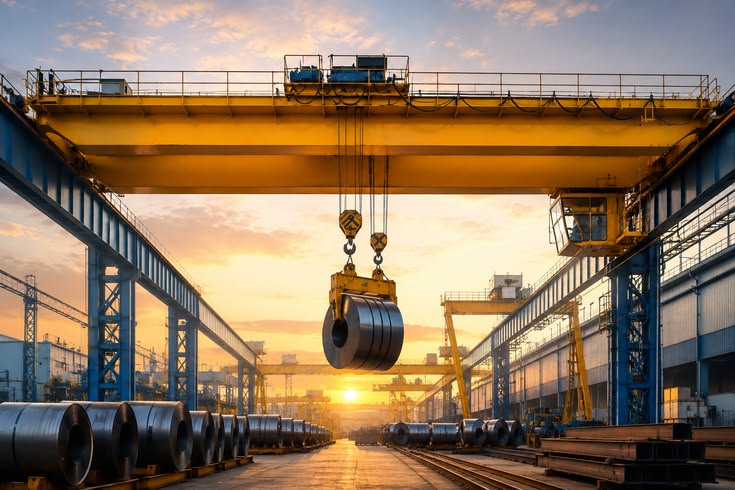
In a busy factory, warehouse, fabrication unit, or industrial plant, lifting equipment has to do much more than simply move a load from one point to another. It should operate multiple times, through varying load conditions and production requirements, requiring limited-space operations and tight production schedules with no compromise on safety. The principle behind the equipment takes on significance in this process. Experienced EOT crane manufacturers in Chennai consider factors such as load capacity, span, lifting height, operating frequency, control systems, structural strength, and the actual working environment before developing a crane. The design of an EOT crane should suit its surroundings, instead of the surroundings fitting it.
Let's dive into this blog to explore what makes an EOT crane ready for real-world industrial demands.
“A reliable EOT crane is built not just to lift heavy loads, but to perform safely and consistently under real industrial conditions.”
Two industrial facilities don't always work in exactly the same way. The crane in a steel fabrication plant could have different requirements than a crane installed in an automobile plant or warehouse. The application must be properly understood prior to manufacture. All of these factors have an impact on the shaping of the end product of the crane. A light materials plant, for instance, might focus on ease of flow and efficiency of plant operation during the day.
If the crane is used on a duty cycle that demands frequent lifting or heavy loads, it might need a heavy-duty model. If the application is a high duty cycle, with frequent lifting or heavy loads, a heavy-duty crane may be required for this situation. This is not just the difference in the amount of weight lifted. A complete Crane system will need to be designed according to the conditions under which it will function. This approach focuses on the application and is one of the first differences between a practical industrial crane and a common overhead lifting machine.
When selecting which EOT crane to purchase, it is easy to assume that tonnage selection is the primary decision. In practice, capacity makes up just one piece of the engineering calculation. To perform safely and in a controlled manner, a crane needs to be capable of lifting the anticipated load. Manufacturers also need to consider how frequently the crane will operate and whether loads will be lifted continuously, occasionally, or under demanding production conditions.
These details can be used correctly from the design phase, so as to minimise issues after installation. The crane could be too large and result in unnecessary oversize investment and structural size, or it could be too small and unable to meet the demands presented to it.
The design of an EOT crane might seem simple at first glance but is capable of bearing high stresses during operation. When a load is lifted and moved by the lift mechanism, the bridge girder, wheel carriage on both ends, wheels, hoisting mechanism, and the various other elements are all in operation. The bridge structure needs to maintain stability while travelling across the runway. Meanwhile, the parts or components supporting them need to be able to resist the forces generated during lifting, accelerating, decelerating, and travel.
This is especially true for applications where the crane is used on a regular basis. Sub-components may be subject to repeated movement, which causes them to be subjected to repeated mechanical stress. A true engineer will therefore consider more than just whether or not a crane can lift this load once. It takes into account the ability of the machine to execute the same process on a regular basis. What most people don't realise is that the performance of the crane actually changes when it comes to the material selection, structural calculations, fabrication quality, welding, alignment and integration of the component parts.
Also Read This:How Technology and Engineering Come Together in Modern EOT Crane Manufacturing
Industrial productivity is not always considered rapid speed of removal of a load. Allowing controlled movement is also as important. The suspended load may flap at sudden start-ups or shutdowns. Such activities can become more challenging to position and can produce greater stress on mechanical parts with excessive movement. The reason for this is that today, most EOT cranes are equipped with operating systems designed to give the crane smoother acceleration, travel, lifting, and braking. Using a combination of these systems, operators can move materials just as easily from one point to another as position them more accurately.
Safety should NOT be considered an extra feature that is added to a crane after its manufacture. It should be taken into account during the design and manufacture process. A crane is at an elevation above the working floor; sometimes the crane will carry materials which may be very heavy. As a result, any problem with lifting or travelling, braking, controls, or structure can pose serious operational risks.
An engineered crane design is only as effective in the field as good manufacturing and installation. The accuracy produced by the fabrication, quality of the welding, the machined parts, their alignment, electrical connections and assembly all contribute to the final machine. It is also crucial at the installation stage. Before placing the crane in regular service, the runway layout, supports, alignment, lighting and operating area should be ensured. This attention to detail ensures that the crane not only can lift the indicated load, but is also suitable for daily use in industry.
Real-world industrial conditions can be demanding. Dust, heat, humidity, continuous operation, restricted space, and varying workloads can all affect equipment performance. The crane therefore needs to be designed with its actual operating environment in mind. Maintenance planning should begin from the day the crane is installed. Regular checks of brakes, ropes, hooks, wheels, electrical systems, controls, and other critical components can help identify wear before it develops into a larger operational problem. Operators also play an important role. Proper training, correct load handling, avoiding unnecessary shock loading, and following operating procedures can significantly influence the service life of the equipment.
“The best EOT crane is not simply the one with greater capacity, but the one designed for the demands of its working environment.”
An EOT crane becomes truly ready for real-world industrial demands when its design reflects the actual requirements of the workplace. Load capacity, structural strength, movement control, safety systems, operator controls, manufacturing quality, and maintenance all contribute to dependable performance. Choosing experienced EOT crane manufacturers in Chennai can help industries develop lifting equipment that is suited to their specific application rather than relying on a one-size-fits-all approach. A properly engineered EOT crane is not simply a machine that lifts heavy materials; it becomes an important part of the daily workflow, supporting safer handling and more efficient industrial operations.
One of the top Crane Manufacturers in Chennai is MH Cranes & Hoists. We are known to be leading manufacturers of EOT Crane, Electric Hoist, Electric Wire Rope Hoist, Electric Chain Hoist, Single Girder EOT Crane, Double Girder EOT Crane, Gantry Crane, JIB Crane, Portable Crane, Underslung Crane, Light Crane System, Standard Electric Wire Rope Hoist, MWH Series Wire Rope Hoist, Standard Budgetary Hoist, Light Duty Hoist, Ultra Low Head Room Hoist, Electric Winch, Engineering Crane Manufacturers in Chennai.
© 2024 Mh Cranes & Hoists. All Rights Reserved. Design and Developed By 


